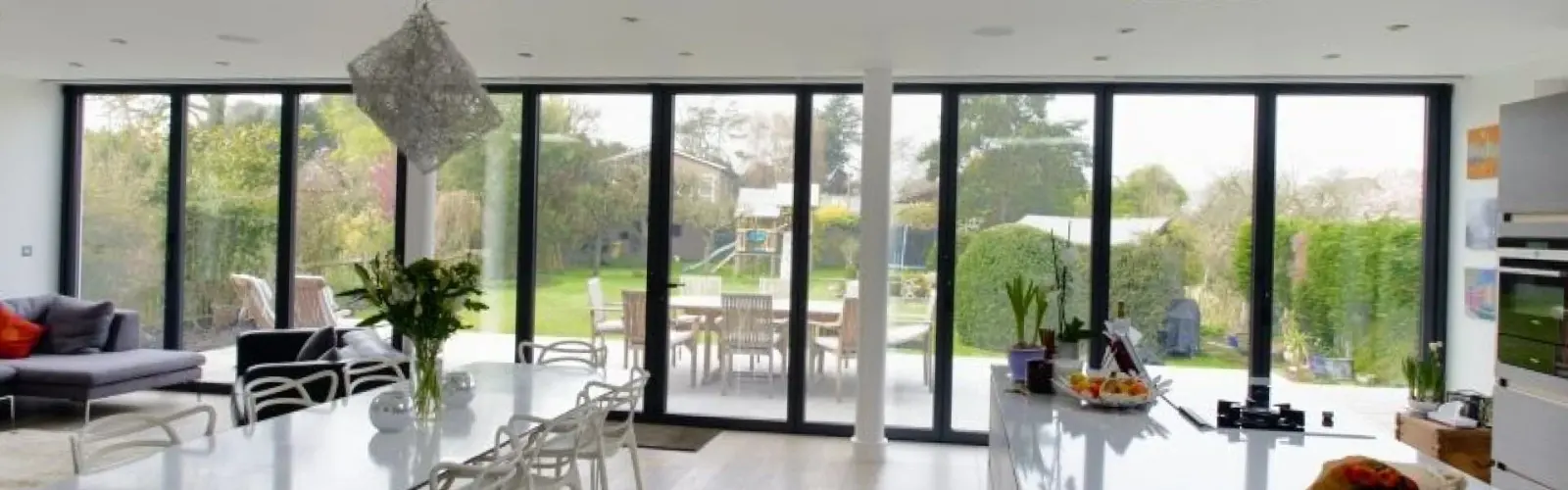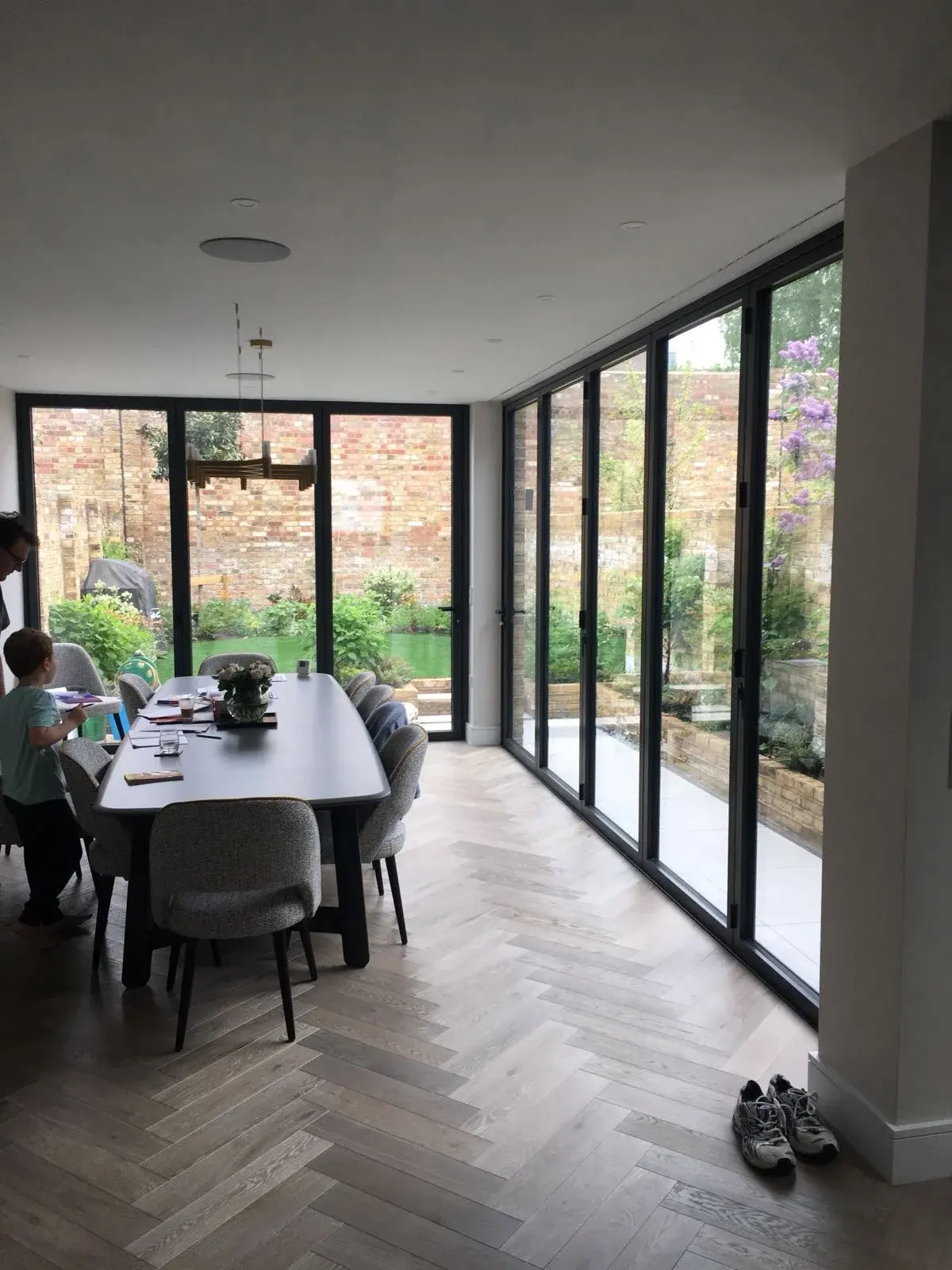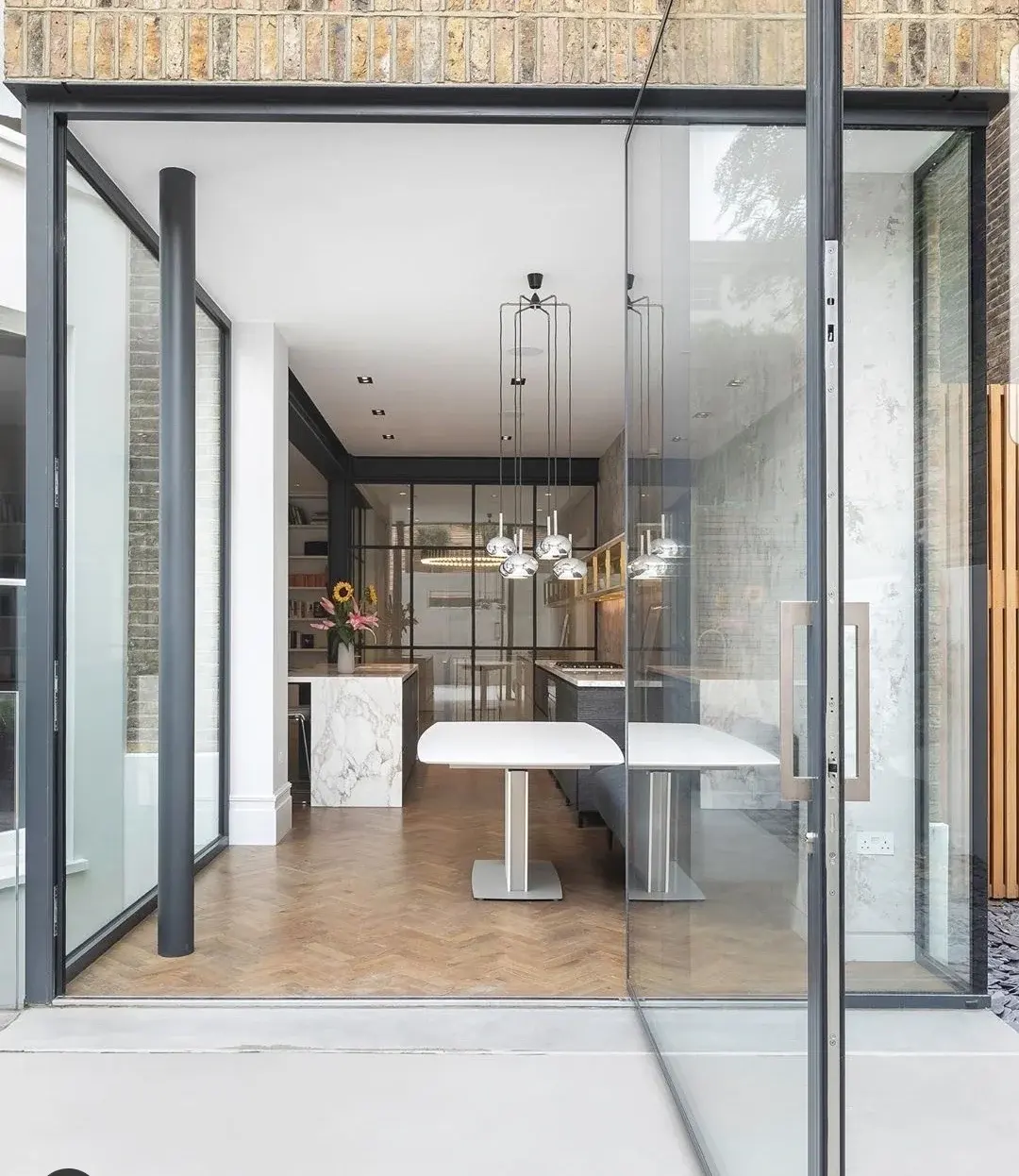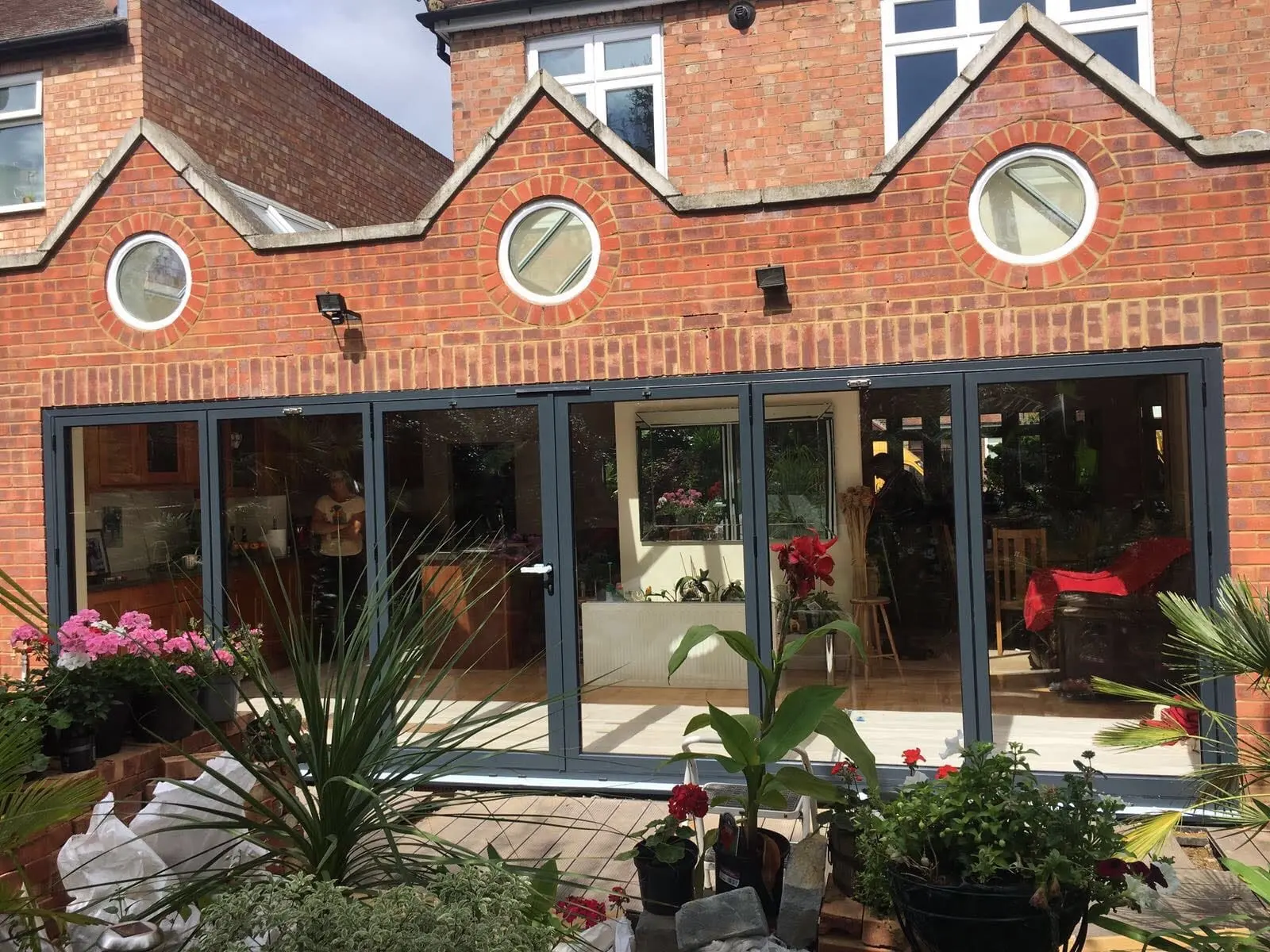
About Commercial Bifold Doors
Commercial bifold doors are folding glazed doors that open a whole shopfront, restaurant frontage or terrace wall to the outside, then close to a secure, weathertight line. BDF Architectural supplies and installs commercial aluminium bifold doors for ground-floor shopfronts, cafés, restaurants and bars, and for office floors that open onto roof terraces, across London and the UK. You can buy them supply only, made to the sizes you send, or supplied and installed, on Schüco AS FD 75/90.HI, Schüco ASS 70 FD and Cortizo folding systems.
What makes a bifold door commercial grade? Five things: hinges, rollers and running gear rated for the leaf weight and for opening many times a day; a traffic door so one leaf works as an everyday door; a threshold chosen for access and for the weather; locking and glass with test evidence for the security the building needs (the Schüco AS FD 75/90.HI, for example, is tested to PAS 24 with burglar resistance to RC 2); and thermally broken frames that meet the Approved Document L limit for doors in buildings other than dwellings. Each is explained below.
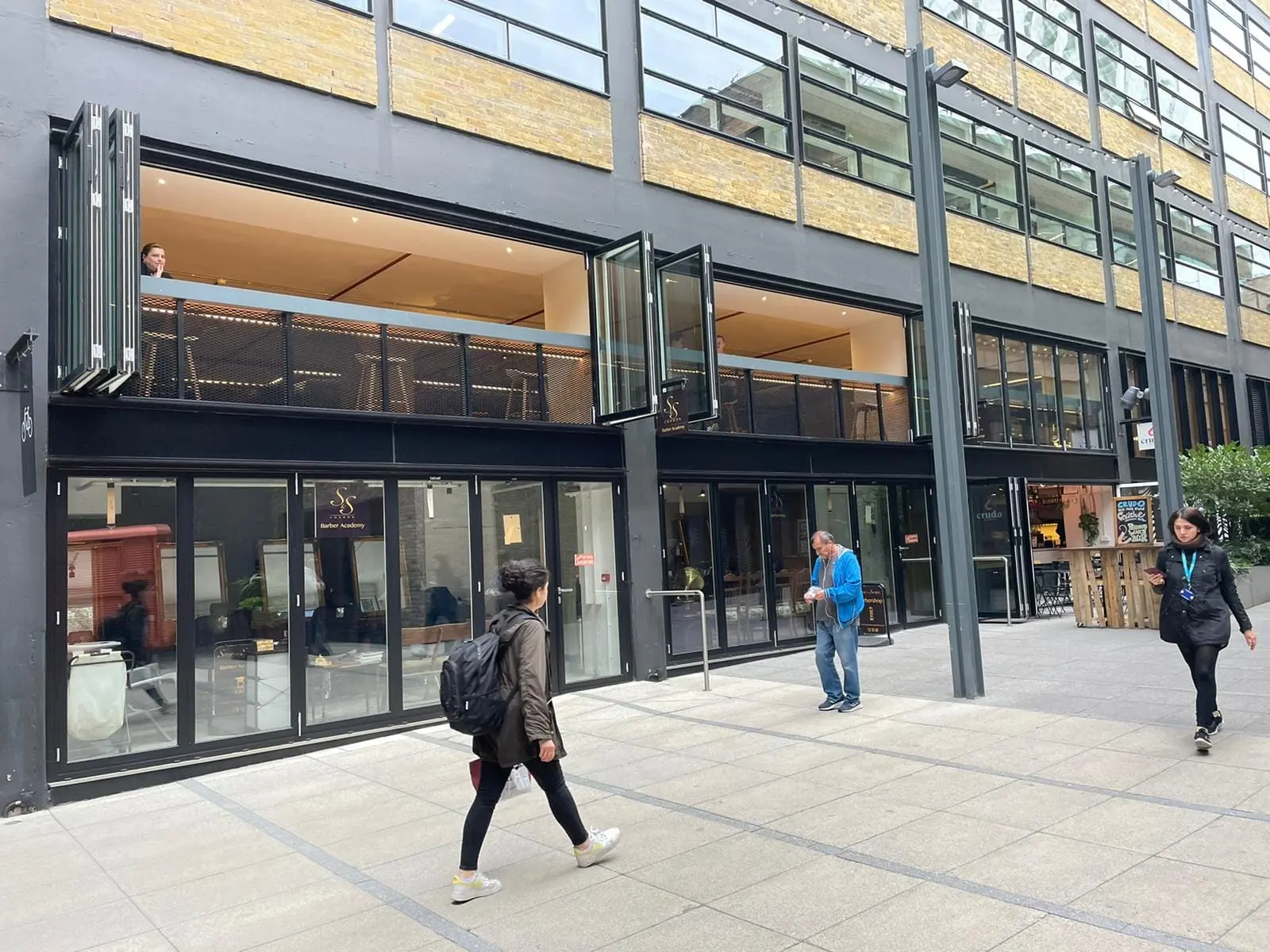
On commercial buildings they take far more use than in a home, so the system, the hardware and the threshold are chosen for traffic, security and access as well as for the look. At Blackfriars in the City of London we fitted black aluminium bifold doors across the ground-floor commercial units, with folding windows to the floor above; at Hammersmith, full-width bifold doors open the office floors onto a roof terrace shaded by brise soleil blades. We work on Schüco and Cortizo folding systems, specified to the opening size, the number of panels, the traffic doorway and the security the building needs, and supplied on their own or as part of a wider commercial glazing package with the windows, entrance doors and curtain walling around them.
Commercial bi-folds are used differently from domestic ones: the set is folded back in good weather but works as an ordinary door for the rest of the year. A traffic door, one leaf that opens on its own with a handle and lock like an entrance door, takes that everyday use, and its position in the set is chosen for the flow of customers, staff and deliveries. If the bifolds are on an escape route, the fire strategy decides whether they can serve as an exit and which leaf does so.
Hardware is where commercial folding doors differ most from domestic ones. Hinges, rollers and running gear are chosen for the weight of the leaves and the number of times the set will be opened, and on busy frontages the bottom track needs keeping clear of grit so the doors keep running smoothly.
The threshold is a balance between access and weather. A low or flush threshold makes the opening easy for wheelchairs, pushchairs and trolleys and helps meet Approved Document M, but it needs drainage in front and careful detailing on exposed elevations; a raised, weathered threshold performs better in driving rain. When the set is closed it has to be as secure as the rest of the frontage, with the leaves locking to each other and to the frame, and laminated glass or a specified security standard met by choosing a system and configuration with test evidence for it.
Sizes depend on the system. Each folding system sets a maximum leaf height, width and weight, and the number of leaves sets the overall width, so very wide frontages are often split into several sets with fixed glazing or a column between them. Schüco AS FD 75/90.HI panels go up to 1,500 mm wide and 3,500 mm high, with threshold options of 71 mm, 15 mm and 4 mm; Schüco ASS 70 FD vents go up to 3.0 m high at 1.2 m wide; and Cortizo Bifold panels up to 1,200 mm wide and 3,000 mm high, with up to 14 sashes in a set. We confirm what the chosen system can achieve for your openings when we price.
Bifold or sliding is the main choice for a commercial frontage. Bifold doors open almost the whole width, which suits restaurants, bars and terraces that trade with the frontage open. Sliding doors take larger panes with fewer frames, but the opening is limited by the panels that stack behind each other, so they suit frontages that are mostly kept closed. For an everyday entrance that is opened hundreds of times a day, a hinged or automatic entrance door within a glazed screen is usually the better choice, and we supply those as commercial aluminium doors.
Bi-parting doors are sometimes searched for alongside bifolds, but they are a different product: two sliding leaves that part from the centre, usually automatic, as on the main entrance of a shop, office or lobby. Where that is what the opening needs, our commercial aluminium doors page covers sliding and automatic entrances; bifolds are the choice when the whole frontage has to fold open.
Thermal performance is set by Approved Document L Volume 2 (2021 edition) in England, which gives a limiting U-value of 1.6 W/m²K for new and replacement pedestrian doors, including glazed doors, in buildings other than dwellings. Thermally broken frames and insulating glass units are what get a folding set there, and the U-value is calculated for the actual panel sizes and glass rather than taken from a brochure. The higher 3.0 W/m²K limit is for high-usage entrance doors, which Approved Document L defines as entrances many people move through, with automatic closers and, where possible, a lobby, so check with building control before relying on it for a folding frontage. The 2026 edition of Approved Document L Volume 2, which takes effect on 24 March 2027, keeps both limits.
Commercial bifold doors can be bought supply only by contractors, shopfitters and installers who fit their own, or supplied and installed by our teams. Each set is made to measure and fabricated in our West Drayton facility.
To price commercial bifold doors, send the opening sizes, the number of sets, the system and colour if known, and programme dates. Supply only and supply and install are both available.
Last reviewed 18 November 2026
On a real projectBlackfriars, City of London →Commercial bifold doors and frontages, 2025Key features
- Full-width openings for shopfronts, restaurants and terraces
- Schüco and Cortizo aluminium folding systems
- Traffic door for everyday access when the set is closed
- Low and accessible threshold options
- Thermally broken aluminium frames
- Coordinated with the windows, entrance doors and curtain walling around them
- Any RAL colour, made to measure for each opening
- Supply only or supplied and installed
- Hinges and running gear chosen for leaf weight and commercial use
- Secure when closed, with security standards met where specified
Specifications
Frequently asked questions
Common questions about Commercial Bifold Doors.
Are aluminium bifold doors suitable for commercial use?
Yes, when the system, hardware and threshold are chosen for commercial traffic. BDF Architectural supplies and installs commercial aluminium bifold doors for shopfronts, cafés, restaurants, bars and office terraces across London and the UK.
What makes a bifold door commercial grade?
Running gear and hinges rated for the leaf weight and frequent use, a traffic door for everyday access, a threshold chosen for access and weather exposure, locking and glass with test evidence for the security required, and thermally broken frames that meet the Approved Document L limit of 1.6 W/m²K for doors in buildings other than dwellings.
Which bifold systems do you use for commercial projects?
Schüco AS FD 75/90.HI, Schüco ASS 70 FD and Cortizo folding systems, specified to the opening size, the number of panels, the traffic door and the security the building needs.
Can staff and customers use a bifold as an everyday door?
Yes. A traffic door lets the set be used like a normal door when it is closed. If the bifolds form part of an escape route, the fire strategy decides whether that is acceptable and which leaf serves as the exit.
Can commercial bifold doors have a level threshold?
Low and accessible threshold options are available; on Schüco AS FD 75/90.HI there are three, at 71 mm, 15 mm and an ultra-low 4 mm. A lower threshold has to be detailed carefully for drainage and weather performance, so it is designed with the floor finishes and the exposure of the opening.
Can I buy aluminium bifold doors for commercial use supply only?
Yes. Contractors, shopfitters and installers can buy commercial aluminium bifold doors supply only, made to measure to their opening sizes, or we can supply and install them. Send the sizes, number of sets, system and colour to price.
How big can commercial bifold doors be?
It depends on the system. Schüco AS FD 75/90.HI panels go up to 1,500 mm wide and, on the AS FD 90.HI, 3,500 mm high, and Cortizo Bifold panels up to 1,200 mm wide and 3,000 mm high, with up to 14 sashes in a set. Very wide frontages are usually split into several sets with fixed glazing or a column between them.
Bifold or sliding doors for a shopfront or restaurant?
Bifold doors open almost the whole width, so they suit frontages that trade open in good weather. Sliding doors take larger panes but open only as far as the stacked panels allow. For an entrance used all day, a hinged or automatic commercial entrance door in a glazed screen is usually the better choice.
Are bi-parting doors the same as bifold doors?
No. Bi-parting doors are two sliding leaves that part from the centre, usually automatic, as on a shop or office entrance. Bifold doors fold back in a concertina so the whole frontage can open. We supply both: bi-parting and other automatic sliding entrances as commercial aluminium doors, and folding frontages as commercial bifold doors.
What U-value do commercial bifold doors need?
In England, Approved Document L Volume 2 (2021 edition) sets a limiting U-value of 1.6 W/m²K for new and replacement pedestrian doors, including glazed doors, in buildings other than dwellings. A new building's energy calculation may call for a better figure. Thermally broken frames and insulating glass units are needed to meet it, and the value is calculated for the actual panel sizes and glass.
Have you installed commercial bifold doors in London?
Yes. At Blackfriars in the City of London we fitted black aluminium bifold doors across ground-floor commercial units, and at Hammersmith full-width bifold doors open office floors onto a roof terrace shaded by brise soleil blades.
How do I get a price for commercial bifold doors?
Send the opening sizes, the number of sets, the system and colour if known, and programme dates through the enquiry form on our contact page, by email to info@bdfa.uk or on 0800 999 5575. Supply only and supply and install are both available.
Pricing Commercial Bifold Doors?
Send drawings, schedules and programme dates for a tender price, or call 0800 999 5575.