
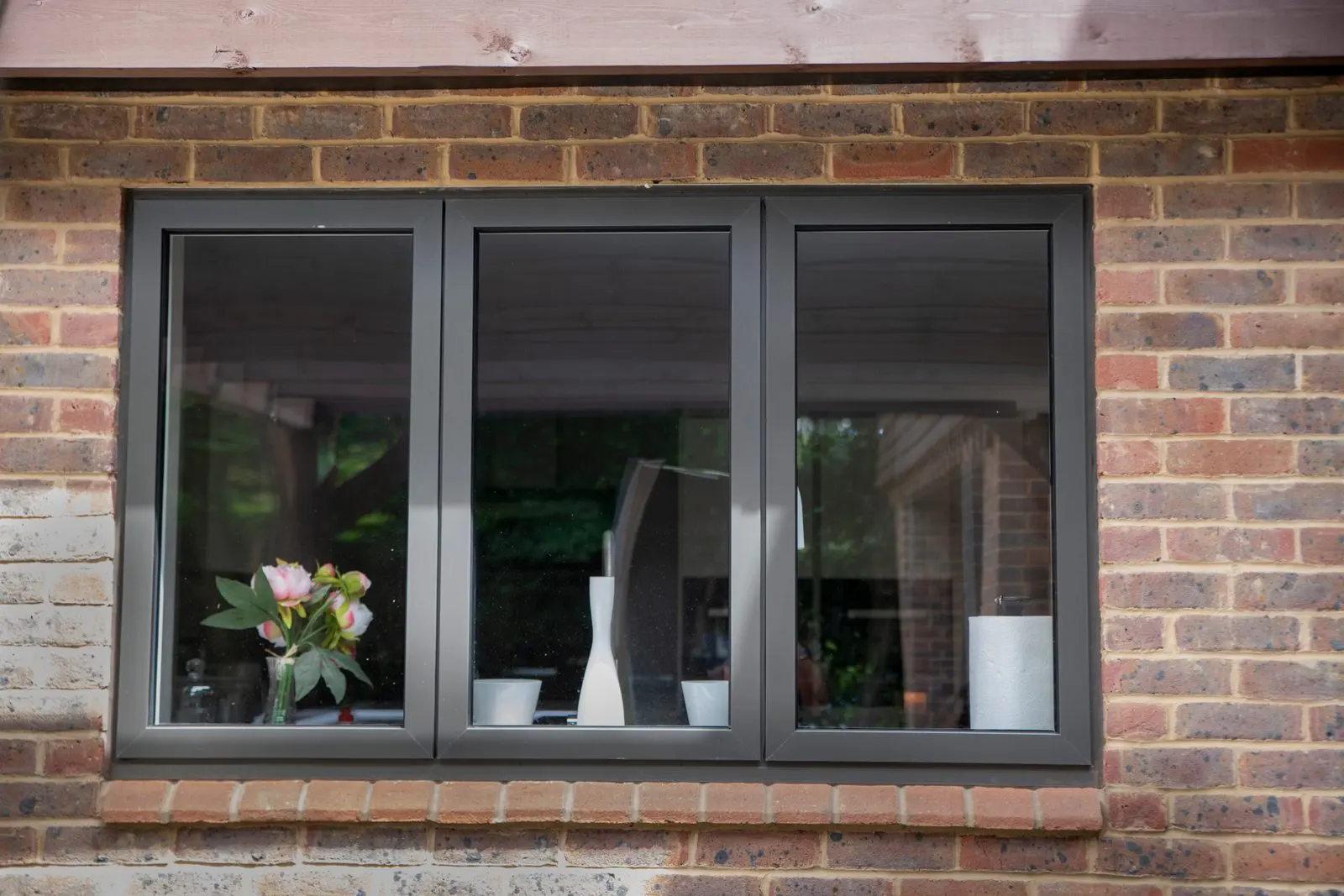
Neither material is better for every home. uPVC windows usually cost less up front, while aluminium windows usually cost more but give slimmer frames, more glass and a wider choice of colours. Both can meet the same UK energy and security standards when they are well made and properly fitted. This guide compares them fairly so you can decide what is worth paying for. To be open about it: BDF Architectural makes aluminium windows and does not sell uPVC.
Aluminium vs uPVC windows at a glance
| Aluminium windows | uPVC windows | |
|---|---|---|
| Up-front cost | Usually higher | Usually lower, which is its main advantage |
| Frame width | Usually slimmer, because the metal is much stiffer | Usually wider, and larger frames often have steel reinforcement inside |
| Large panes | Suits big, heavy panes such as triple glazing | Fine for typical sizes; very large panes are harder |
| Energy efficiency | Needs a thermal break; good systems meet Part L | PVC insulates naturally; good systems meet Part L |
| Colour | Powder coated in a very wide range of colours, often different inside and out | White is standard; coloured foils and finishes are widely available |
| Lifespan | Long-lasting; no reliable figure shows it outlasts uPVC | Long-lasting; quality and installation matter most |
| Recycling | Widely recycled and can be recycled again and again | Can be recycled; how much is depends on the maker and scheme |
| Security | Depends on locks, glass and fitting; ask for PAS 24 evidence | Depends on locks, glass and fitting; ask for PAS 24 evidence |
Aluminium vs uPVC windows cost
uPVC windows usually cost less to buy than aluminium windows of the same size and type. For a house full of standard casements, that is a fair reason to choose them. Aluminium usually costs more because the profiles, the thermal break and the coated finish all add to the price.
Prices depend on the size, glass, opening type, colour and access, so a guide price without your sizes would not tell you much. Compare like for like: the same sizes, glass and opening types in both materials. Some homeowners accept the higher cost of aluminium because they expect it to last longer and want the slimmer look. Whether that pays off depends on how long you plan to stay in the house.
Strength and frame width: where aluminium differs
Aluminium is a much stiffer material than PVC. That lets an aluminium frame stay narrow while it carries large, heavy panes of glass. uPVC frames usually need to be wider to stay rigid, and larger uPVC frames typically have steel reinforcement inside. In practice an aluminium window usually shows less frame and more glass in the same opening.
This matters most on modern designs: large picture windows, tall windows and heavy triple-glazed units. For example, the Cortizo Arch Invisible tilt and turn window has a visible sightline of 66mm and hides its handle and hinges, and the Schüco AWS 70.HI takes glazing units up to 52mm thick. On a small casement the difference may matter less, and good uPVC can look perfectly neat.
Energy efficiency of aluminium and uPVC windows
Aluminium conducts heat well, which is why older aluminium windows had a reputation for feeling cold and gathering condensation on the frame. Modern aluminium windows use a thermal break: an insulating strip, usually polyamide, that separates the inside of the frame from the outside. PVC conducts heat poorly, so uPVC frames insulate well without one, using air chambers inside the profile.
The glass makes up most of a window, so the glazing has a big effect on the result. That is why a well-made window in either material can meet the same standard. In England, Approved Document L sets the limit for a replacement window in an existing home: a whole-window U-value of 1.4 W/m²K or better, or a Window Energy Rating of band B. New windows in an extension are generally held to the same limit. A new edition of Approved Document L takes effect on 24 March 2027 and keeps the same figures for windows in existing homes.
Ask for the whole-window U-value
Frame (Uf) and centre-pane (Ug) figures are not the whole-window figure. The Schüco AWS 70.HI, for example, has a frame U-value (Uf) from 1.6 W/m²K, so whether a finished window reaches 1.4 depends on the glass and the size. Ask each supplier, aluminium or uPVC, for the whole-window U-value or WER band for your actual windows.
Lifespan and maintenance of aluminium and uPVC windows
Both materials are long-lasting. Aluminium frames do not rot or rust, and a powder-coated finish usually needs nothing more than an occasional wash, more often near the sea. uPVC is also low maintenance. Some older white uPVC can discolour over time, and coloured foils can be marked if they are damaged. On either material, hinges, locks and seals need an occasional check.
There is no single reliable lifespan figure for either material. The quality of the profile, the hardware, the installation and how exposed the window is all matter as much as the material. Compare the written guarantees you are offered rather than general claims.
Recycling and environmental impact
Aluminium is widely recycled and can be recycled again and again without losing its properties. Making new aluminium from ore uses a lot of energy, so the recycled content of a profile makes a real difference to its footprint. uPVC windows can also be recycled, and old PVC frames can be reprocessed into new profiles, though how much of a given window is recycled varies by maker. Ask each supplier about recycled content and what happens to your old frames.
Security, safety glass and the rules for both materials
Security comes from the locks, hinges, glass and fitting more than from the frame material, and windows in both materials are commonly tested to PAS 24. On a new home, Approved Document Q says easily accessible windows should be shown by test to meet PAS 24 or a similar standard. Easily accessible broadly means within 2m of the ground, an access balcony or a low flat roof. Part Q applies to new dwellings only, including those formed by a change of use, not to replacement windows in an existing home.
Safety glass rules apply whatever the frame. Under Approved Document K, replacing a whole window (frame and glass) is building work. Glass within 800mm of the floor in a window is a critical location, where it should break safely, be robust or in small panes, or be permanently protected. In practice that usually means toughened or laminated glass. Approved Document K also covers guarding, such as under an opening window with a low sill on an upper floor.
Who signs off replacement windows
In England, an installer registered with a competent person scheme such as FENSA or CERTASS can self-certify a replacement window in an existing home. Schedule 3 to the Building Regulations 2010 lists this work, and the installer must give you a certificate and tell building control the work is done. If the installer is not registered, or the windows are new rather than replacements, for example in an extension or a new opening, the work goes through building control instead. The frame material makes no difference to this.
Planning is a separate question. Changing windows on a house often does not need planning permission, but flats do not have the same permitted development rights as houses, an Article 4 direction can remove those rights in some areas, and changes that affect the character of a listed building need listed building consent. Permitted development also requires materials of a similar appearance to the existing house, so switching from uPVC to aluminium that looks clearly different may need permission. Check with your council before you change the frame material.
Aluminium or uPVC windows: which should you choose?
- Choose uPVC if: budget is the priority, your windows are standard sizes, and you are happy with white or a foiled colour and wider frames
- Choose aluminium if: you want slim frames and more glass, large or tall panes, a particular colour, or windows that match aluminium doors (our aluminium vs uPVC bifold doors guide covers the door side)
- Either way: ask for the whole-window U-value or WER band, PAS 24 evidence where security matters, safety glass where Part K needs it, and sign-off through a competent person scheme or building control
If you choose aluminium, the way the window opens matters as much as the brand. Our aluminium windows range covers tilt and turn windows and casements on the Schüco AWS 70.HI, outward-opening windows on the Schüco AWS 70 SC, Cortizo 4900 sliding windows and the Cortizo Arch Invisible. Where you want the fine lines of steel, we make Jansen steel windows.
Frequently asked questions
Are aluminium windows better than uPVC?
Not in every case. Aluminium windows usually have slimmer frames, suit larger panes, and offer more colour choice. uPVC windows usually cost less up front and insulate well. Both can meet the same UK energy and security standards.
Do aluminium windows cost more than uPVC?
Usually, yes. uPVC is normally the cheaper option for the same size and type of window. The gap depends on the sizes, glass, opening type and colour, so compare quotes for the same specification in both materials.
Are aluminium windows colder than uPVC?
Not if they are thermally broken. Modern aluminium windows have an insulating strip inside the frame. In England, a replacement window must have a whole-window U-value of 1.4 W/m²K or better, or a Window Energy Rating of band B, whichever material it is made from.
Do replacement windows need building regulations approval?
In England, replacement windows must meet the Building Regulations. An installer registered with a competent person scheme can self-certify the work, so no separate approval application is needed, and must give you a certificate. Otherwise, the work needs approval from building control.
Can I replace uPVC windows with aluminium?
Yes. Aluminium windows are made to measure, so they can usually be made to fit existing openings. If you live in a flat, a listed building or an area covered by an Article 4 direction, check with your council first, as changing the frame material may need permission.
Which lasts longer, aluminium or uPVC windows?
Both are long-lasting, and there is no reliable figure showing that either outlasts the other. The quality of the profile, hardware and installation matters as much as the material, so compare the written guarantees you are offered.
Sources and further reading
- Approved Document L: conservation of fuel and power (GOV.UK)
- Approved Document L (2026) (GOV.UK)
- Approved Document Q: security in dwellings (GOV.UK)
- Approved Document K: protection from falling, collision and impact (GOV.UK)
- The Building Regulations 2010, Schedule 3: self-certification schemes (legislation.gov.uk)
- The Building Regulations 2010, regulation 20 (legislation.gov.uk)
- Competent person schemes (GOV.UK)
- The Town and Country Planning (General Permitted Development) (England) Order 2015 (legislation.gov.uk)
- Planning (Listed Buildings and Conservation Areas) Act 1990, section 7 (legislation.gov.uk)
BDF Architectural makes aluminium windows to measure on Schüco and Cortizo systems, from West Drayton in west London. We supply and install across London and the South East, or supply only. Send us your window sizes for a price, or visit our West Drayton showroom to see working examples.
Get a free quote