
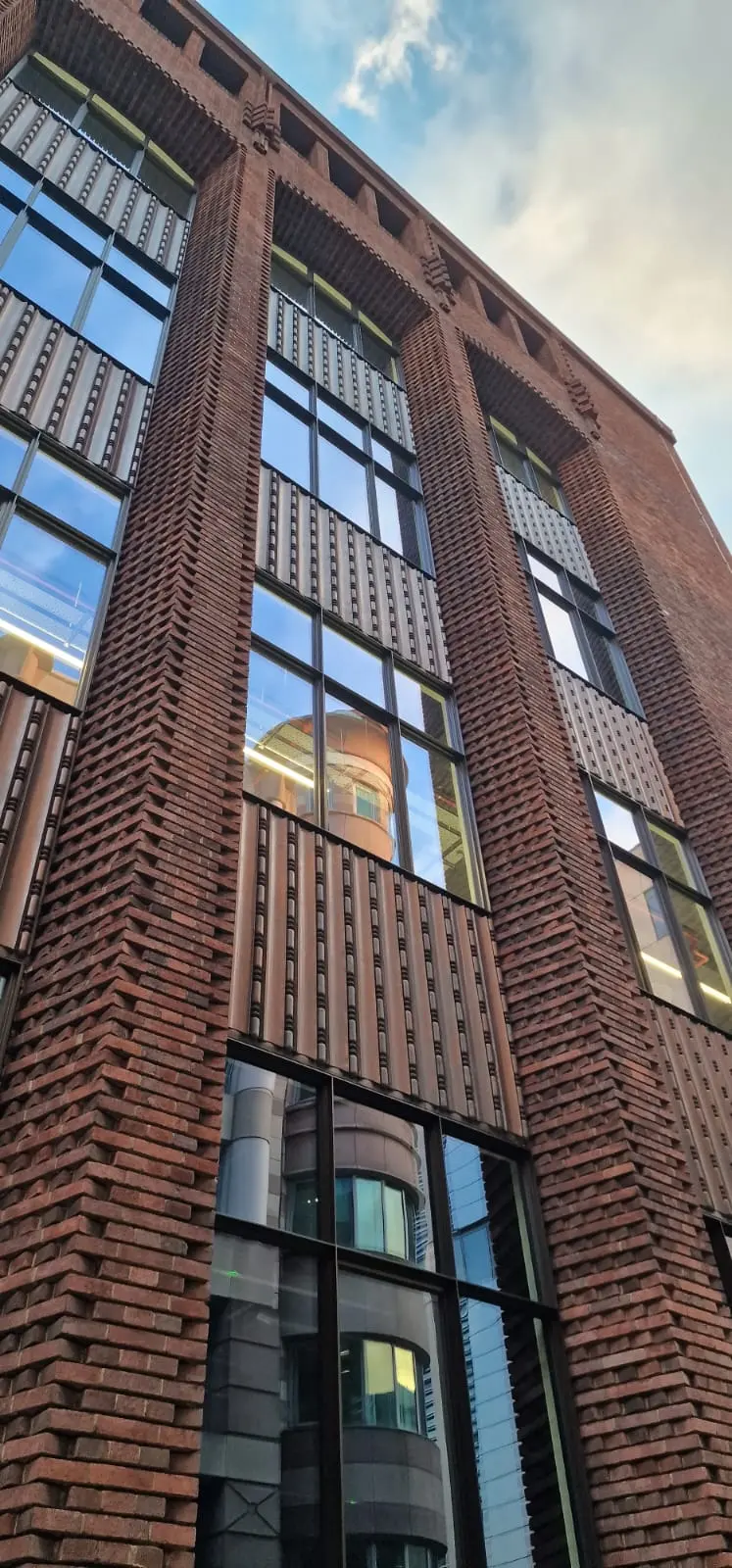
The façade package — cladding, curtain walling, windows and entrance systems — is often the largest subcontract on commercial and higher-density residential projects. It is also the most complex to coordinate, combining architectural intent, structural interfaces, waterproofing, thermal compliance and fire performance. Early engagement with your specialist façade and cladding contractor is one of the highest-value actions a main contractor or developer can take. This guide compares the main aluminium façade and cladding systems, sets out the fire rules for external walls in England, and covers the interfaces, programme and information that decide how a façade package is priced and delivered.
Choosing an aluminium façade system
Most commercial elevations combine systems: glazed areas in curtain walling, stick-built or unitised, and solid areas in rainscreen cladding, with perforated metal, brise soleil or louvres added where shading or screening is needed. The choice for each part of the building follows its height, the repetition in the façade grid, the programme and site access.
| System | What it is | Typical use | Programme point |
|---|---|---|---|
| Stick curtain walling | Mullions and transoms fixed to the slab edges, then glazed and sealed on site | Low- and mid-rise buildings, podiums, entrance screens, irregular elevations and smaller areas | Can start on site sooner; slower per floor than unitised |
| Unitised façade | Factory-assembled, glazed panels lifted onto brackets at each floor and interlocked | Tall buildings, large repetitive grids, tight programmes and restricted city sites | Design and fabrication are front-loaded; each floor is weathertight as soon as its units are in |
| Aluminium rainscreen cladding | Aluminium panels on brackets and rails in front of an insulated backing wall, with a drained and ventilated cavity | Solid areas of new buildings, and re-cladding existing ones | The backing wall and framing need structural information early |
| Perforated metal | Perforated sheet, usually carried on a framing system in the same way as rainscreen | Screening plant, car parks and balconies; shading glazing | Pattern and open area are agreed early, as they set light, air and view |
Aluminium rainscreen cladding
Aluminium rainscreen cladding uses an outer layer of aluminium panels separated from the building's insulated wall by a ventilated cavity. Water that gets past the outer panels drains and dries out in the cavity, which makes the system well suited to the UK climate. The panels are carried on a cladding framing system of adjustable brackets and rails, fixed back to the backing wall, often an SFS (light gauge steel framing) infill wall or masonry, or to the slab edge, and the framing and its anchors must be designed to carry the panel weight and wind load safely.
- Backing wall: a steel framing system (SFS) or masonry, made airtight and weathertight
- Sheathing board: stiffens the frame; A2-s1,d0 or A1 on relevant buildings
- Breather membrane: keeps wind-driven rain out while letting vapour escape
- Mineral wool insulation, typically A1, mechanically fixed to the backing wall
- Open-state intumescent cavity barrier at the floor line: lets the cavity drain and ventilate, and closes in a fire
- Adjustable bracket on a thermal isolator pad, fixed through the insulation to the backing wall or slab edge
- Vertical rail carrying the panels, with fixed and sliding points for thermal movement
- Ventilated cavity, usually around 25 to 50 mm or more: air enters at the base and leaves at the top, and any water that gets in drains out at the base
- Rainscreen panel, for example a solid aluminium cassette, with open or baffled joints
Aluminium rainscreen panels come in a wide range of profiles — flat, cassette, hook-on and secret-fix — and finishes including powder coating, anodising and PVDF coating. Panel size and fixing centres depend on panel thickness, profile and wind load, and should be confirmed by the system designer's calculations. Perforated metal panels add screening and texture where the design calls for it. Our guide what is rainscreen cladding explains joint types, insulation, membranes and the key details in more depth.
Unitised façade systems
Unitised façades are made from factory-assembled panel units — typically one storey high and one bay wide — that are delivered to site and craned into position floor by floor, interlocking with neighbouring units. Compared with stick-built curtain walling, the main advantages are programme speed (installation can follow closely behind the frame), less site labour and better quality control through factory fabrication.
Unitised systems suit projects with tight programmes, large repetitive façade grids or restricted site access. The higher fabrication cost is often recovered through shorter installation time and lower site preliminaries. Our guide what is a unitised façade covers stack joints, cranage and how unitised compares with stick curtain walling, and our curtain walling specification guide covers system types, thermal performance and testing.
Cladding fire safety rules after Grenfell
Since the Grenfell Tower fire, the rules on external walls in England have changed substantially through amendments to the Building Regulations and Approved Document B, and through the Building Safety Act 2022. Regulation 7(2) bans combustible materials in the external walls of relevant buildings — broadly, buildings with a storey 18 m or more above ground that contain flats or other residential or institutional accommodation. Materials must achieve class A2-s1,d0 or A1 under BS EN 13501-1, with specific exemptions listed in Regulation 7(3), such as window and door frames, glass and seals.
- Relevant buildings with a storey 18 m or more above ground: external wall materials must be A2-s1,d0 or A1, subject to the Regulation 7(3) exemptions
- Other buildings over 18 m, such as offices: outside Regulation 7(2), but Approved Document B still limits combustible materials in their external walls, so the façade must be justified against the fire strategy
- Residential buildings between 11 m and 18 m: Approved Document B guidance, not Regulation 7(2), sets the expectations for external wall materials
- Metal composite panels with an unmodified polyethylene core — the type used at Grenfell — are no longer permitted in the external walls of new buildings in England, whatever their height
- EWS1 forms, used by mortgage lenders on existing blocks of flats, require the external wall to be assessed by a suitably qualified professional
For other buildings with a storey 18 m or more above ground, Approved Document B also allows a large-scale fire test of the whole wall build-up to BS 8414, assessed against BR 135; that route is not available for relevant buildings. Cavity barriers are needed within rainscreen cavities, typically at floor levels, around openings and at compartment walls, and the slab-edge gap behind curtain walling has to be fire stopped. On higher-risk buildings, broadly those at least 18 m or seven storeys tall with at least two residential units, the Building Safety Regulator is the building control authority and the design must be approved before work starts. The project fire strategy, and a fire engineer where needed, should confirm the classification each part of the wall requires.
Façade interfaces: where packages go wrong
Most façade problems start at the junctions between systems and trades rather than in the middle of a panel, so a package that puts the systems on either side of a junction with one contractor removes a common source of leaks, cold bridges and disputes. The interfaces to draw early are:
- Rainscreen to windows and curtain walling: heads, sills and reveals need trims and closures that keep the cavity drained and ventilated, with cavity barriers around openings where required
- Curtain walling to the slab edge: the fire-stopping line, brackets and tolerances, and who is responsible for each
- Brackets for brise soleil, louvres and fins: they pass through the weather line and insulation, so they are coordinated with the façade they fix to
- Parapets, soffits and the base of the wall: copings, ventilation and drainage openings, and the junction with roofing and ground-floor details
- The backing wall: who provides the SFS or masonry, sheathing board and membrane, and what the cladding brackets can fix into
Façade programme and procurement
- Engage a specialist façade contractor by RIBA Stage 3 — earlier engagement reduces design risk and improves programme certainty
- Allow for long design, approval and fabrication lead times on unitised systems, and confirm them at tender rather than assuming a standard period
- Confirm rainscreen lead times early, as they vary with panel type and finish
- Coordinate the backing wall, often SFS infill, and the cladding framing with the frame programme — early structural information saves cost
- Include a mock-up in the specification to resolve interface issues before production starts
What to send for a façade tender price
- Elevations, plans, sections and details at windows, floors, parapets, base and corners
- The performance specification, with thermal and acoustic targets and any preferred systems or acceptable equivalents
- Building height, use and fire strategy, including whether Regulation 7(2) applies or the building is higher-risk
- The backing wall and structure, slab-edge information and interfaces with other packages
- Programme dates, access and logistics constraints, and any testing or mock-up requirements
On Pentonville Road in Islington, for example, we delivered a curtain wall system across the full façade of a mixed-use development. See our commercial capability for how we take a façade package from technical review to handover.
Frequently asked questions
What is rainscreen cladding?
Rainscreen cladding is an outer layer of panels fixed in front of a building's insulated wall, with a ventilated cavity between them. Water that passes the outer panels drains away in the cavity instead of reaching the wall behind.
What is a unitised façade?
A unitised façade is made from large factory-assembled panels, typically one storey high, that are craned into place and interlock with each other. It reduces site labour and speeds up the programme compared with stick-built curtain walling.
Can aluminium cladding be used on buildings over 18 m?
Yes, provided the materials meet the fire rules. On relevant buildings with a storey 18 m or more above ground, external wall materials must be class A2-s1,d0 or A1, so panels, insulation and other components must be chosen and evidenced accordingly.
What is the difference between curtain walling and rainscreen cladding?
Curtain walling is itself the weather line of the building: a glazed or panelled framework hung from the structure floor by floor. Rainscreen cladding is a ventilated outer layer of panels fixed in front of a solid backing wall that does the weatherproofing. Many buildings use both, with curtain walling on the glazed areas and rainscreen on the solid ones.
When should a façade contractor be appointed?
Ideally by RIBA Stage 3. Slab-edge details, bracket positions, the backing wall, fire strategy and, on unitised work, the crane strategy and fabrication lead time all depend on the façade design and are hard to change once the frame is under way.
Should curtain walling and cladding be let as one package?
Often, yes. Most façade problems start at the junctions between systems, so putting curtain walling, rainscreen cladding and shading with one contractor means the interfaces are designed, fabricated and installed by the same team. Where they are let separately, the responsibility for each junction should be set out in the package scopes.